
Overcoming Dissociation: A Personal Journey from Emotional Neglect to Healing
I didn’t know I was dissociating then, and I certainly wouldn’t have used that word. I just knew one thing for certain: I didn’t want to feel anything that was negative, painful, or uncomfortable.
My initial therapy journey started focused on the immediate grief of losing my teaching career. But, as therapy often does, the focus quickly shifted to deeper, more foundational wounds: my childhood trauma and the emotionally abusive relationship I endured for five and a half years with my high school boyfriend.
Dredging up the pain of these experiences each week felt like picking a bloody wound that would never heal. The sudden, raw realization that I had been profoundly affected by childhood emotional neglect was more than my system could handle.
I didn't want to walk around feeling like I’d been run over by a truck, and I was willing to do anything I could not to feel that crushing weight.
My Experience with Emotional Neglect & Trauma
In my attempt to outrun the pain, I developed elaborate avoidance rituals that became my daily survival mechanisms.
I’d scroll Pinterest for hours, creating endless lists of DIY projects for my house. I planned over-the-top birthday parties for my daughters. I searched Google endlessly for the answer to make everything feel okay.
The Illusion of Control: Micromanaging Life
My avoidance didn't stop with simply numbing my own negative emotions; it extended outward to my entire family. I couldn't bear to let my husband or girls feel anything bad either.
I became overbearing and micromanaged every interaction between my husband and my daughters, and even the interactions between the girls themselves. One hint of someone being upset sent me into a tailspin. I'd immediately become the fixer and do whatever it took to make the discomfort stop.
What I didn’t understand at the time was that this behavior—the scrolling, the fixing, the micromanaging—was all a form of dissociation. It had become a rigid pattern for me, a way to meet my emotional need for certainty.
If I could check out, fix things, control the environment, or keep everyone calm, it created an illusion of safety. It felt predictable. It felt like I was proactively preventing the next bad thing from happening.
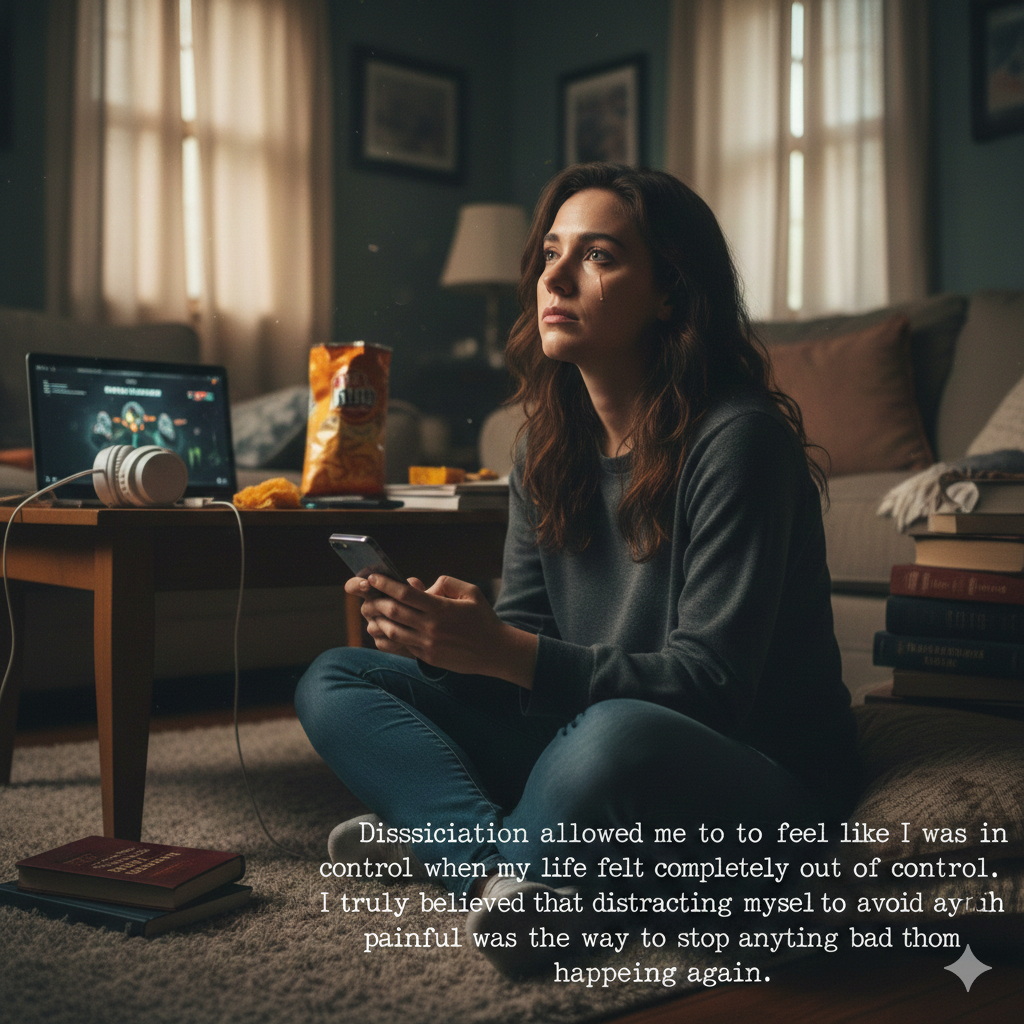
Dissociation allowed me to feel like I was in control when my life felt completely out of control. I truly believed that distracting myself to avoid anything painful was the way to stop anything bad from happening again.
What Is Dissociation? The Self-Care Myth
Unfortunately, the world around us often reinforces this avoidance.
In my therapy journey, my therapist encouraged me to "check out" and even pushed anti-anxiety meds on me, telling me it would be the key to getting me out of the metaphorical ditch. Things haven’t changed much: therapists, coaches, and self-help articles still make dissociation sound normal—even healthy. Like it’s a necessary part of self care strategies.
Most of us were raised to believe that feeling anything other than happy, grateful, or “positive” is fundamentally bad. We’re taught to calm down, stay strong, be fine, and keep it together. Of course, dissociation seems like the intuitive answer because it lets you bypass the uncomfortable emotions you were never taught how to feel in the first place.
The Dilution of a Serious Coping Mechanism
Honestly, the phrase ‘I’m dissociating’ has become so diluted in modern culture that most people don’t even know what it means anymore.
People use it as a way to justify their avoidance and numb out. They genuinely believe they’re advocating for themselves by declaring they are "checking out."
Dissociation becomes the go-to coping mechanism, and before you know it, it becomes part of your personality.
You spend more and more time watching Netflix and scrolling social media, deeply entrenched in overcoming dissociation by simply defining yourself by it.
You start to see yourself as someone who “can’t handle things,” so checking out feels like the only viable option.
The more you do it, the more it feels like the only way to keep yourself safe, comfortable, and in control.
The cruel illusion is that people think dissociation takes them away from pain. It doesn’t. It just lets you bypass the trigger, the initial wave of discomfort. The problem with this strategy is that you never truly understand why you were overwhelmed in the first place.
Unlearning Old Coping Strategies: The Cycle Breaker
The real shift in mental health recovery comes when we finally understand that dissociation isn't helping us—it’s actually keeping us permanently stuck.
I had to confront this harsh reality in my own emotional healing journey. I had to embark on a difficult, but necessary, process of unlearning:
I had to unlearn the idea that survival strategies are self-care. Distraction is not rest. Avoidance is not peace.
I had to unlearn the belief that feeling nothing meant I was okay. Numbness is a form of pain.
I had to unlearn the coping strategies that only gave me relief, not healing.
And this is the part that truly made me stop in my tracks and finally see the pattern:
Relief feels like pleasure, but it’s not. Relief is just the buffer between pain and pleasure. Once the relief wears off, the original pain is still right there.
This is why we keep dissociating over and over again. We are chasing a fleeting buffer, not genuine resolution.

Moving Toward Healing: Creating New Safety
Now that I understand the mechanism of what I was doing, I don’t use dissociation to stop myself from feeling anymore.
Dissociation doesn’t stop on its own. This is a powerful cycle that must be consciously broken.
It doesn’t happen by forcing yourself to "feel more" or shaming yourself for watching Netflix. It starts by creating new ways to feel safe that actually work.
Emotional healing comes from knowing, deep down in your nervous system, that you can handle your emotions without being consumed by them.
I’ve learned how to sit with my emotions and be present instead of instantly shutting down or frantically micromanaging everything around me.
I’m not chasing relief.
I’m not confusing numbness with peace.
I’m not avoiding discomfort because it feels like danger.
I know that I don’t have to throw my hands in the air and run from things to feel safe. You don’t either.
Advice for Others Struggling with Dissociation
If your current coping with trauma strategy involves checking out, scrolling, or constantly fixing, understand that you are not flawed—you are using a highly effective survival mechanism that is now outdated.
The goal isn't to eliminate the impulse to dissociate; the goal is to replace the source of safety it provides with something genuine.
Self Care Strategies for Genuine Presence
Stop Labeling, Start Noticing: Instead of saying, "I'm dissociating," try saying, "I feel a strong urge to check out right now." This simple shift moves you from identifying with the pattern to noticing the pattern, creating a space for choice.
Micro-Doses of Feeling: If a wave of anxiety hits, don't try to feel it all at once. Commit to staying present for 60 seconds. Focus on your feet on the floor, or the texture of your shirt. This teaches your system that the emotion will pass without consuming you.
Validate the Root Need: Acknowledge that the anxiety relief you seek is actually a deep need for safety and certainty. Address the need directly, not the symptom (dissociation). For example: "I feel unsafe right now, so I will go set a boundary with my phone instead of scrolling."
Embrace the Mess: Accept that healing is messy, and you will not feel happy and positive all the time. Emotional healing means allowing for a full range of human experience, including the pain associated with healing after abuse.
If I could go back and tell my old self anything, the one who was constantly running and fixing and checking out, it would be this:
You don’t need to dissociate from your life to survive it. You just need a new way to create safety for yourself.
Start building that new way today. Your life—the one you are currently bypassing—is waiting for you.
I’m Kim Keane, certified coach and energy healer, and I’d love to help you transform your life, your relationships and ultimately build a path toward a loving, peaceful life. DM me or email me at kim@kimkeane.com if you want to get personalized support, download my Free Everyday Spirituality Handbook or get my EFT Tapping Booster Session to continue making progress on your healing journey. You’re doing great and it’s never too late!